Kingston’s Story:
Learn what it means to live like Kingston—and how his spirit inspires hope for children and the families facing pediatric brain cancer.
Kingston’s Story and Enduring Legacy
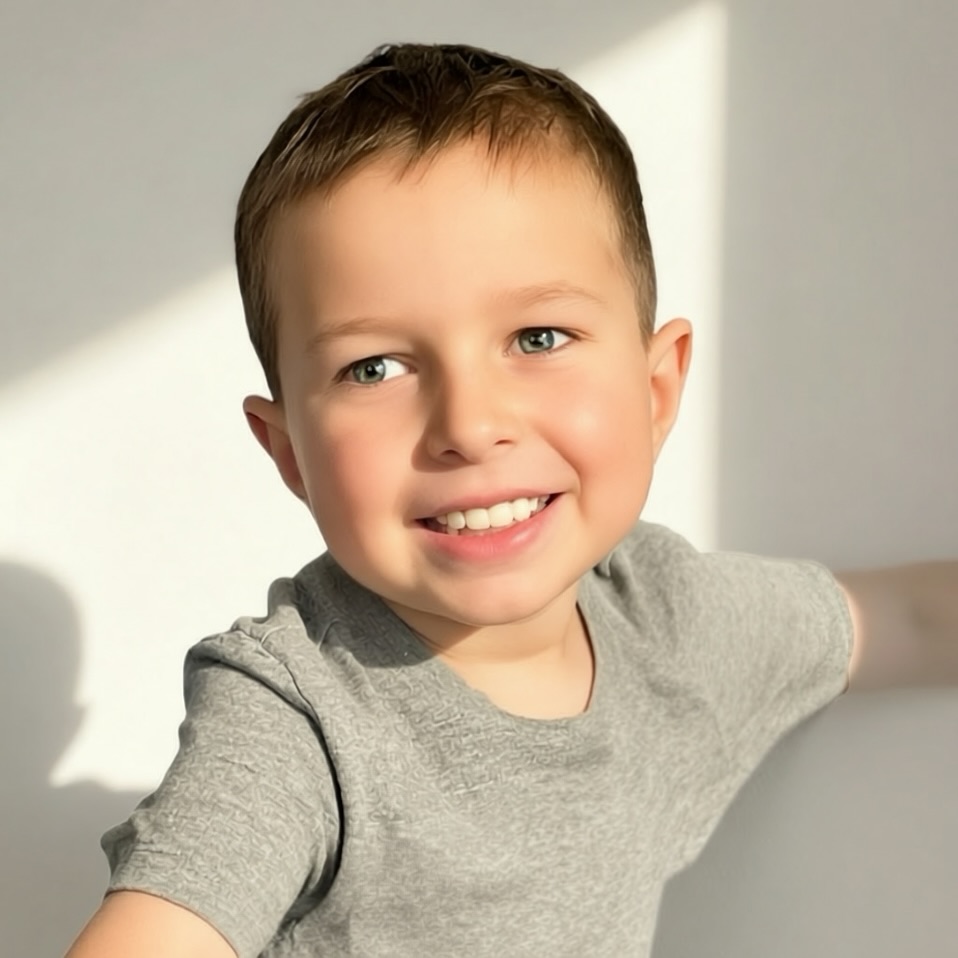
Kingston Navarro was never just a diagnosis. He was never just a timeline of treatments or surgeries or outcomes. He was a kid with a presence that shifted a room, a sense of humor that caught people off guard, and a way of making people feel connected without even trying. He had a pull to him. People paid attention. They stayed longer. They cared more. Even in places where most people shut down, Kingston made things feel lighter.
He also wasn’t supposed to be here. I was told I couldn’t have more children, that the chances were slim to none. Kingston didn’t care about any of that. He showed up anyway, like he had already decided this was happening. From the beginning, there was something steady about him, something that felt intentional.
In 2018, Kingston was diagnosed with brain cancer, and from the start, the odds were stacked against him. We were facing something like a five percent chance of survival. That is not a number you sit with comfortably. It is something you either let define you or you decide, somehow, that it won’t.
What followed was everything modern medicine can put a child through. Six months of chemotherapy. Thirty rounds of high dose radiation to his brain. A stem cell transplant that required his immune system to be wiped out and rebuilt. Two brain surgeries. Long hospital stays. Complications that never gave warning. And then posterior fossa syndrome, which changed everything again.
He lost his ability to speak. Not briefly, not in passing. He was mute for months. A kid who had a personality that filled a room suddenly couldn’t use his voice. His body stopped responding the way it used to. He couldn’t eat or swallow on his own for nearly a year. Every meal became medical. Every day required intervention just to sustain him. He developed neurogenic bowel and bladder, which meant nothing about basic function was automatic anymore. Everything had to be managed, planned, monitored. There was no break from it.
Then came rehabilitation, which is where the reality of this kind of illness really lives. He did not just “go to therapy.” He lived in it. For two years, we cycled through intensive programs that were four hours a day, five days a week, three weeks at a time, just to get him to walk again. Not improve. Not strengthen. Walk. Speech therapy lasted for years, not just to talk, but to relearn breath support, coordination, and clarity. Progress came slowly, unevenly, and never without effort.
The cognitive impact stayed. He never learned to read. He could not write. School became another system we had to fight to make even partially accessible. We pushed for IEPs, sat in meeting after meeting, explained what he had been through, and still faced resistance and delays. Even with everything documented, the burden stayed on us to prove that he needed help.
At the same time, we were searching outside the system for anything that might support him. We found DMI and used a neurosuit to help retrain his body and rebuild movement patterns. We found hippotherapy, using the movement of a horse to help with balance, regulation, and strength in ways traditional therapy could not. These were not offered to us. They were not easy to access. They were things we had to find, push for, and often fund ourselves.
This is where the gaps are. This is what families are left to figure out on their own.
And still, through all of it, Kingston came back in ways people did not expect. Not to perfect health, not to who he was before, but to a version of life that most people would not have thought possible. He learned to walk again. He played baseball on a regular team. Not a modified version, not something separate, a regular team, and everyone knew what he had been through. People rooted for him in a way that had nothing to do with the score. He had beaten something he was not supposed to beat.
For a while, it looked like we had made it.
Then in September 2022, the cancer came back. This time it was more aggressive. The options were fewer. The conversations changed.
We kept going. A year of treatments that did not work. A clinical trial that we hoped would change everything, and instead left him worse off. Three spinal surgeries followed, and one of them he walked away from in a way that felt like a miracle. The kind of moment that makes you think maybe, somehow, he is going to outrun this again.
And then he didn’t.
After everything he had already survived, everything he had fought his way back from, we were right back in it again. The clinical trial that was supposed to give us another option left him worse off. The progress he had clawed his way toward started slipping, and there was nothing clean or predictable about it.
He went through three spinal surgeries. Each one carrying its own set of risks, each one something no child should ever have to face. And somehow, after one of them, he walked away from it in a way that felt impossible. The kind of moment that makes a room go quiet because nobody can quite explain what they’re seeing. It felt like a miracle. It felt like maybe he was going to do it again, maybe he was going to outrun this a second time.
But this time, the ground didn’t hold.
Then it was radiation again. More treatment layered onto a body that had already been pushed past what it should have been able to handle. This wasn’t starting fresh. This was asking a body that had already endured years of damage, years of recovery, years of rebuilding, to go back into something that had already taken so much from him.
At some point, the fight changed whether we wanted it to or not. This was no longer about beating it. It was about buying time. Holding onto moments. Stretching whatever we had left.
He knew that.
His body started shutting down in ways that don’t feel real until you are living inside of them. He lost the ability to speak again. After everything he had done to get it back, it was gone. He couldn’t eat. His strength faded. Everything that had taken years to rebuild started slipping away, piece by piece.
And there is nothing that prepares you for that part. Nothing.
The decisions in front of us were the kind no parent should ever have to make, and I let him make them.
He chose to come home.
No more hospitals. No more trying to force time into a body that was done. He wanted to be where he felt safe. With me. With Zuma. In a place that felt like his.
Doctors said one or two weeks.
Kingston stayed for seven.
Seven weeks of him still being here, still finding ways to connect, still showing up in the middle of everything his body was going through. He kept communicating with us until just hours before he passed. We held hands. We touched our pointer fingers together, the small signal we had made up that meant “I love you.” Even when everything else was being taken from him, that stayed.
On July 18th, at 4:18 pm, Kingston took his final breath in my arms.
And even then, somehow, he was still leading.
He had always told me to breathe when things felt overwhelming. Slow. Steady. In and out. In that moment, I matched my breath to his. I followed him through something I never would have believed I could survive. It was the hardest thing I have ever done, and he showed me how to do it.
That was Kingston.
He didn’t just endure what happened to him. He changed the experience of it for everyone around him. He made doctors stay longer. He made strangers care. He made other families feel less alone in rooms where no one should ever have to sit. He made people laugh when nothing about the situation was funny. He made the unbearable feel, somehow, survivable for one more minute.
And when you step outside of that world, the reality is impossible to ignore.
Families are expected to figure all of this out on their own. The treatment. The rehabilitation. The education system. The financial strain. The long-term effects. The impact on siblings. What happens when treatment ends. What happens when it doesn’t.
And at the end of all of it, there is nothing for caregivers.
We lived that. I know exactly where the gaps are because we fell into them, over and over again.
Live Like Kingston exists because of that. Because of everything he went through, everything he fought through, and everything that should have been different for him and wasn’t.
His story didn’t end when he died. It continues in the people he changed, in the families who will be supported because of him, and in every effort to make this path less isolating for the ones still walking it.
He was the light of my life, and a light in the dark for so many. In his honor, we don’t stop. We don’t look away. We keep fighting for better for kids like Kingston and the families who love them.